
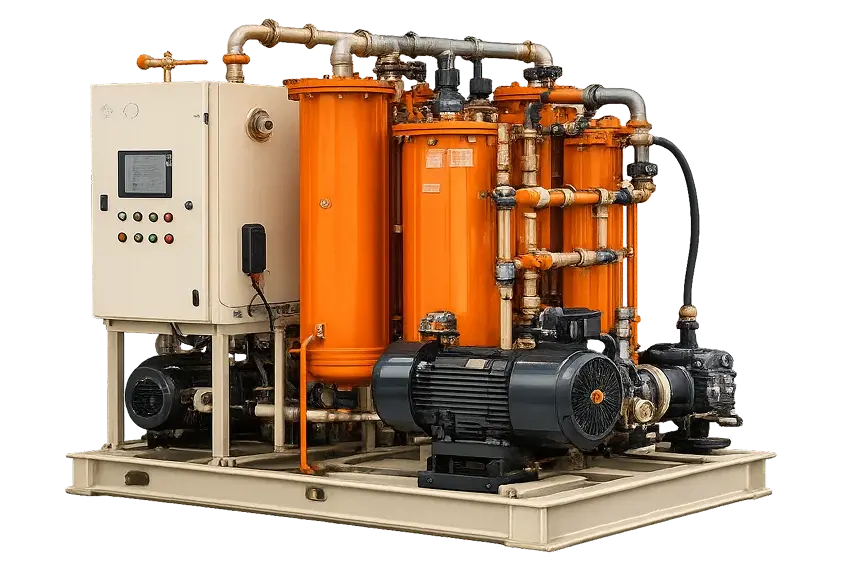
If you want to understand the true health and longevity of an industrial plant, don't just look at the final product rolling off the line—look closely at the compressed air. It is the invisible muscle moving the entire operation, powering everything from delicate robotic arms to massive pneumatic presses. Yet, it is constantly under attack from within.
Moisture, oil aerosols, and microscopic particulates are the silent saboteurs of the factory floor. When raw air is compressed, the concentration of these contaminants skyrockets. If you could visualize the inside of an unprotected pneumatic pipeline under cinematic, high-resolution lighting, you wouldn't see a smooth flow of power. You would see a destructive, abrasive storm. Water droplets cause internal steel textures to rust and flake, oil creates sticky sludge that jams delicate valves, and solid particulates act like sandpaper against high-speed pneumatic cylinders.
I often tell our junior engineers that designing a compressed air dryer and filtration system is exactly like designing a mechanical immune system. It requires an obsessive pursuit of purity. We engineer these systems to isolate and extract contaminants at a microscopic level because we understand that the air entering a machine dictates its lifespan.
When we install a system that delivers completely clean, dry, and contamination-free air, we aren't just selling a piece of equipment. We are stripping away the friction. We are giving our clients clean, modern efficiency and buying them years of uninterrupted, headache-free production. Good filtration doesn't just protect the machinery; it protects the entire operational ecosystem.